You can see an array of 1-5 minute video clips that give a feel for the more than 1000 persons assembling at Liederhalle in Stuttgart, Germany
Youtube LWFweb section
Showing posts with label #lwf2010. Show all posts
Showing posts with label #lwf2010. Show all posts
Saturday, July 24, 2010


Friday, July 23, 2010
Singing in the Tunnel
Singing Veni Spiritus in the Tunnel, Marking Reconciliation
By Maria Erling
ELCA Delegate to the LWF Assembly
The procession underground went through the modern, granite surfaced tunnel between the plenary hall and the worship room. Were there a thousand of us? Hard to tell from the front, where the Mennonite and Lutheran choirs sang their way through. We sang a version of “Come Holy Spirit,” and it carried us into a service of confession. The tunnel gave our song a rich welcome. The prayer echoed ahead of us and behind.
Then began a service of testimony and song that recited the stories of persecution. We heard stories of the Anabaptist martyrs and learned how another community was formed. We listened as our Mennonite sisters and brothers acknowledged that a dark history told by victims can also do a kind of damage, and prevent a people from becoming all they can be. So, both of our communities will be transformed by this, and in that work made more fully alive in Christ.
But the other healing thing that happened through this honest recital was that we Lutherans, that is all of us – African, Asian, Latin American, European, Nordic, and North American - accepted that the harm done in the 16th century and continued through five centuries is a history that would not be buried or forgotten by us.
So we sang our way through to a new day.
By Maria Erling
ELCA Delegate to the LWF Assembly
The procession underground went through the modern, granite surfaced tunnel between the plenary hall and the worship room. Were there a thousand of us? Hard to tell from the front, where the Mennonite and Lutheran choirs sang their way through. We sang a version of “Come Holy Spirit,” and it carried us into a service of confession. The tunnel gave our song a rich welcome. The prayer echoed ahead of us and behind.
 |
| photo by Arni Svanur Danielsson |
But the other healing thing that happened through this honest recital was that we Lutherans, that is all of us – African, Asian, Latin American, European, Nordic, and North American - accepted that the harm done in the 16th century and continued through five centuries is a history that would not be buried or forgotten by us.
So we sang our way through to a new day.
Follow the Questions
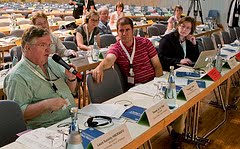
by John Spangler, From Stuttgart
How does the world view Lutherans in this kind of a global gathering? To answer that, I followed the questions that people have been asking. In this case, mostly press and media questions.
From the pre assembly news conference and subsequent conferences taking place within the assembly time frame, the world and its media representatives press their questions to LWF leaders. In the pre assembly event, all questions were related to human sexuality in one way or another. The ELCA’s decision, joining the Church of Sweden in formal openness to the ordination and recognition of persons in faithful same gender relationships, elicited questions about whether disagreements among the LWF member churches, particularly Africa, would surface. A second focus, still centered on sexuality, was the abrupt resignation of German Bishop Maria Jepsen over the weekend before the assembly. (Jepsen resigned in response to clergy sexual abuse cases within her jurisdiction that did not receive proper intervention in a timely way.) One German newspaper noted that it was the third German bishop to resign (2 Lutherans, one Roman Catholic) with in a year’s time. Jepsen is listed as a delegate to the assembly but has not attended to date.
In a later conference, the questions from media shifted slightly toward the search for conflict, signs of what they believe to be potentially underlying clashes among the Lutheran churches around sexuality. This shift was triggered by questions raised by delegates in a plenary session in response to Bishop Hanson’s report on Wednesday, wondering why the U.S. church, and by implication, the church of Sweden, moved ahead on sexuality questions when the LWF is calling for a five year period of study and conversation. A second delegate from Africa wanted to know what the nature of the communion of churches is in which this kind of decision might be made by some churches. But the secular media members’ other questions also picked up on disagreements over the ordination of women among the churches, a kind of extension of the tensions around sexuality. Bishop Hanson clarified that membership in the LWF does not require the ordination of women, but that the LWF is on record within its membership to supporting those churches that do (which is a very strong majority) and encouraging those that do not to consider adoption of the practice.
More pointed questions from secular and ecumenical outlets searched for possible rifts in the LWF’s unity. Here LWF leaders responded with frustration around the belief that some non-LWF member entities in the Lutheran tradition may be trying to use either scripture or the Lutheran confessions to define who is and who is not Lutheran, or who is and who is not confessionally pure. There appeared to be a frustration among some leaders that there are thinly veiled attempts to fragment the Lutheran world and use issues of women’s ordination or human sexuality as a wedge.
Other questions included one about the hopes the leaders might have for the 2017 anniversary of the Lutheran Reformation, is there ecumenical work going on around the prospect of common communion for couples who belong to ecumenically diverse traditions, such as Lutheran and Roman Catholic spouses, and one about the fragility of family and church life in the North, the isolation and scarcity of young people in church life.
Thursday, July 22, 2010
Hail and Farewell and ‘The Dialogue Must Continue’ -- Day 2
by John Spangler, from Stuttgart
Thanksgivings mingled with the undercurrent of farewells on day two of the assembly. The greetings of Walter Cardinal Kasper were received with affection by the assembly, even as they highlighted the unfinished work of ecumenism, the dialogues, and the greater common work of Christian unity. Kasper, who came “home” to Stuttgart for the greeting (he was bishop of Stuttgart) has been in a farewell tour mode, it seems, and cited the significant friendships that have been forged through long history of ecumenical contact with the Lutherans. If Kasper were the only key figure to retire, that wind may not have prevailed, but with the retirement of General Secretary Noko and the conclusion of the LWF President’s term (Bishop Hanson), the text of the song was thank you, carry on in faith the work of unity, and farewell.
As one would expect, Kasper cited the Joint Declaration on the doctrine of Justification as the highlight of his four decades of dialogue. He said that this work doesn’t belong to any person or tradition, but that “the ecumenical movement is God’s own movement… to bring us together to reconcile ourselves to him.” Whether Catholic or Lutheran, “as Christians,” he said, “we can no longer afford our differences. The dialog must continue. Where there is no communion there is no peace.”
Dialogues are still an unfinished agenda, said Kasper, and “the Catholic church is determined to continue.” Here I suspect an unspoken context is that some among Lutherans who have been arguing against the ELCA’s 2009 decision to permit the ordination of homosexual persons in monogamous, lifelong committed relationships would bring an end to such commitments and common work. Ecumenical partners appear to remain in their commitments, even where there might be significant disagreement on this issue.
Thanksgivings mingled with the undercurrent of farewells on day two of the assembly. The greetings of Walter Cardinal Kasper were received with affection by the assembly, even as they highlighted the unfinished work of ecumenism, the dialogues, and the greater common work of Christian unity. Kasper, who came “home” to Stuttgart for the greeting (he was bishop of Stuttgart) has been in a farewell tour mode, it seems, and cited the significant friendships that have been forged through long history of ecumenical contact with the Lutherans. If Kasper were the only key figure to retire, that wind may not have prevailed, but with the retirement of General Secretary Noko and the conclusion of the LWF President’s term (Bishop Hanson), the text of the song was thank you, carry on in faith the work of unity, and farewell.
As one would expect, Kasper cited the Joint Declaration on the doctrine of Justification as the highlight of his four decades of dialogue. He said that this work doesn’t belong to any person or tradition, but that “the ecumenical movement is God’s own movement… to bring us together to reconcile ourselves to him.” Whether Catholic or Lutheran, “as Christians,” he said, “we can no longer afford our differences. The dialog must continue. Where there is no communion there is no peace.”
Dialogues are still an unfinished agenda, said Kasper, and “the Catholic church is determined to continue.” Here I suspect an unspoken context is that some among Lutherans who have been arguing against the ELCA’s 2009 decision to permit the ordination of homosexual persons in monogamous, lifelong committed relationships would bring an end to such commitments and common work. Ecumenical partners appear to remain in their commitments, even where there might be significant disagreement on this issue.
Wednesday, July 21, 2010
News alert -- Global Lutheran Communion and Mennonites to Mark Reconciliation
Luherans to Ask Forgiveness for Past Persecutions of Anabaptists -- Mennonite response to include gift from Nickle Mine Community
An Action toward Reconciliation with Anabaptists
The most prominent ecumenical action at the July 2010Lutheran World Federation Assembly will be the request for forgiveness—first from God, and then from Mennonite brothers and sisters from the Anabaptist tradition. With theological support from such leaders as Martin Luther and Philip Melanchthon, Lutherans in the 16th century violently persecuted and even executed Anabaptists. These actions remain vivid in Anabaptist memory.
Results of the Lutheran – Mennonite International Study Commission (2005-2008) provide common perspectives on this painful history and allow Lutherans to recognize not only past wrongs but also “inappropriate, misleading, and hurtful portraits” of Anabaptists to the present day. Based on this study, the LWF Council in October 2009 unanimously approved the request for forgiveness. While important theological differences remain, these can be explored in a new atmosphere when the legacy of the persecutions is addressed.
In this action, the LWF prays “that God may grant to our communities a healing of our memories and reconciliation.” Mennonites have indicated that they are eager to respond. This action by the Lutheran communion to address faithfully a sorrowful legacy has significance for the entire Body of Christ.
Further information will be made avialable Thursday morning 08:00 in Stuttgart that is currently embargoed information.
More details are available at
http://www.lwf-assembly.org/explore/lutheran-mennonite-reconciliation/
The event is streamed from the same website and scheduled for the afternoon of thursday here (between 16:30 and 18:00), early morning EDT
Text of the statement:
http://www.lwf-assembly.org/uploads/media/Mennonite_Statement-EN.pdf
______________________________
The Rev. John R. Spangler
Lutheran Theological Seminary at Gettysburg
And Co-opted Staff for LWF Assembly, Stuttgart, Germany
An Action toward Reconciliation with Anabaptists
The most prominent ecumenical action at the July 2010Lutheran World Federation Assembly will be the request for forgiveness—first from God, and then from Mennonite brothers and sisters from the Anabaptist tradition. With theological support from such leaders as Martin Luther and Philip Melanchthon, Lutherans in the 16th century violently persecuted and even executed Anabaptists. These actions remain vivid in Anabaptist memory.
Results of the Lutheran – Mennonite International Study Commission (2005-2008) provide common perspectives on this painful history and allow Lutherans to recognize not only past wrongs but also “inappropriate, misleading, and hurtful portraits” of Anabaptists to the present day. Based on this study, the LWF Council in October 2009 unanimously approved the request for forgiveness. While important theological differences remain, these can be explored in a new atmosphere when the legacy of the persecutions is addressed.
In this action, the LWF prays “that God may grant to our communities a healing of our memories and reconciliation.” Mennonites have indicated that they are eager to respond. This action by the Lutheran communion to address faithfully a sorrowful legacy has significance for the entire Body of Christ.
Further information will be made avialable Thursday morning 08:00 in Stuttgart that is currently embargoed information.
More details are available at
http://www.lwf-assembly.org/explore/lutheran-mennonite-reconciliation/
The event is streamed from the same website and scheduled for the afternoon of thursday here (between 16:30 and 18:00), early morning EDT
Text of the statement:
http://www.lwf-assembly.org/uploads/media/Mennonite_Statement-EN.pdf
______________________________
The Rev. John R. Spangler
Lutheran Theological Seminary at Gettysburg
And Co-opted Staff for LWF Assembly, Stuttgart, Germany
Subscribe to:
Posts (Atom)