Friday, July 23, 2010

Follow the Questions

The Questioners’ Questions
by John Spangler, From Stuttgart


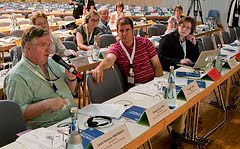
How does the world view Lutherans in this kind of a global gathering? To answer that, I followed the questions that people have been asking. In this case, mostly press and media questions.

From the pre assembly news conference and subsequent conferences taking place within the assembly time frame, the world and its media representatives press their questions to LWF leaders. In the pre assembly event, all questions were related to human sexuality in one way or another. The ELCA’s decision, joining the Church of Sweden in formal openness to the ordination and recognition of persons in faithful same gender relationships, elicited questions about whether disagreements among the LWF member churches, particularly Africa, would surface. A second focus, still centered on sexuality, was the abrupt resignation of German Bishop Maria Jepsen over the weekend before the assembly. (Jepsen resigned in response to clergy sexual abuse cases within her jurisdiction that did not receive proper intervention in a timely way.) One German newspaper noted that it was the third German bishop to resign (2 Lutherans, one Roman Catholic) with in a year’s time. Jepsen is listed as a delegate to the assembly but has not attended to date.

In a later conference, the questions from media shifted slightly toward the search for conflict, signs of what they believe to be potentially underlying clashes among the Lutheran churches around sexuality. This shift was triggered by questions raised by delegates in a plenary session in response to Bishop Hanson’s report on Wednesday, wondering why the U.S. church, and by implication, the church of Sweden, moved ahead on sexuality questions when the LWF is calling for a five year period of study and conversation. A second delegate from Africa wanted to know what the nature of the communion of churches is in which this kind of decision might be made by some churches. But the secular media members’ other questions also picked up on disagreements over the ordination of women among the churches, a kind of extension of the tensions around sexuality. Bishop Hanson clarified that membership in the LWF does not require the ordination of women, but that the LWF is on record within its membership to supporting those churches that do (which is a very strong majority) and encouraging those that do not to consider adoption of the practice.

More pointed questions from secular and ecumenical outlets searched for possible rifts in the LWF’s unity. Here LWF leaders responded with frustration around the belief that some non-LWF member entities in the Lutheran tradition may be trying to use either scripture or the Lutheran confessions to define who is and who is not Lutheran, or who is and who is not confessionally pure. There appeared to be a frustration among some leaders that there are thinly veiled attempts to fragment the Lutheran world and use issues of women’s ordination or human sexuality as a wedge.

Other questions included one about the hopes the leaders might have for the 2017 anniversary of the Lutheran Reformation, is there ecumenical work going on around the prospect of common communion for couples who belong to ecumenically diverse traditions, such as Lutheran and Roman Catholic spouses, and one about the fragility of family and church life in the North, the isolation and scarcity of young people in church life.

Thursday, July 22, 2010

Lutheran Reconciliation with Mennonites Intense, Emotional, and Moving Action

Lutheran and Mennonite Reconciliation today, Thursday the 22nd


Mennonite gift to LWF

In response to the Lutheran and Mennonite reconciliation, today Larry Miller, whoserves as General Secretary of the Mennonite World Conference presented a gift of a footwashing bucket to the Lutheran World Federation today,

The gift followed an intense and heartfelt introduction to action, and included a vote with many delegates voting on their knees in repentence before God and in request of forgiveness from the Mennonites.

The gift is a pine well bucket, a varnished wooden pail, roughly 20 by 20 inches, with narrow steel rings around the outside, a steel handle. Essentially it looks like a well bucket.

The bucket is engraved with the following: “Given to the Lutheran world federation by Mennonite world conference with deepest gratitude on this day of repentance and forgiveness. From this day forth let us serve one another as our Lord and Teacher served us. (John 13:1-17)” and dated 22 July Stuttgart

The “Footwashing Pail” was made by the Anabaptist community in the Nickle Mines area. “in the Nickle Mines area” is due to the fact that they are a “modest community” and Larry Miller, out of respect for their reticence about being in the media spotlight.  It is from one of the Anabaptist communities in Eastern Pennsylvania that still practices foot washing. Footwashing is done prior to the Lord’s Supper as a sign of service and reconciliation.

The Old Order Amish community at Nickel Mines in Lancaster County, PA, came into a tragic spotlight on October 2, 2006 when a gunman took ten girls hostage in the one room school house, killed five and committed suicide in the school. The response of reconciliation and forgiveness and the resistance in the Amish community to express anger or bitterness was widely discussed in both churches and wider public across the country.

Hail and Farewell and ‘The Dialogue Must Continue’ -- Day 2

by John Spangler, from Stuttgart


Thanksgivings mingled with the undercurrent of farewells on day two of the assembly. The greetings of Walter Cardinal Kasper were received with affection by the assembly, even as they highlighted the unfinished work of ecumenism, the dialogues, and the greater common work of Christian unity. Kasper, who came “home” to Stuttgart for the greeting (he was bishop of Stuttgart) has been in a farewell tour mode, it seems, and cited the significant friendships that have been forged through long history of ecumenical contact with the Lutherans. If Kasper were the only key figure to retire, that wind may not have prevailed, but with the retirement of General Secretary Noko and the conclusion of the LWF President’s term (Bishop Hanson), the text of the song was thank you, carry on in faith the work of unity, and farewell.

As one would expect, Kasper cited the Joint Declaration on the doctrine of Justification as the highlight of his four decades of dialogue. He said that this work doesn’t belong to any person or tradition, but that “the ecumenical movement is God’s own movement… to bring us together to reconcile ourselves to him.” Whether Catholic or Lutheran, “as Christians,” he said, “we can no longer afford our differences. The dialog must continue. Where there is no communion there is no peace.”

Dialogues are still an unfinished agenda, said Kasper, and “the Catholic church is determined to continue.” Here I suspect an unspoken context is that some among Lutherans who have been arguing against the ELCA’s 2009 decision to permit the ordination of homosexual persons in monogamous, lifelong committed relationships would bring an end to such commitments and common work. Ecumenical partners appear to remain in their commitments, even where there might be significant disagreement on this issue.

Wednesday, July 21, 2010

News alert -- Global Lutheran Communion and Mennonites to Mark Reconciliation

Luherans to Ask Forgiveness for Past Persecutions of Anabaptists -- Mennonite response to include gift from Nickle Mine Community

An Action toward Reconciliation with Anabaptists

The most prominent ecumenical action at the July 2010Lutheran World Federation Assembly will be the request for forgiveness—first from God, and then from Mennonite brothers and sisters from the Anabaptist tradition. With theological support from such leaders as Martin Luther and Philip Melanchthon, Lutherans in the 16th century violently persecuted and even executed Anabaptists. These actions remain vivid in Anabaptist memory.

Results of the Lutheran – Mennonite International Study Commission (2005-2008) provide common perspectives on this painful history and allow Lutherans to recognize not only past wrongs but also “inappropriate, misleading, and hurtful portraits” of Anabaptists to the present day. Based on this study, the LWF Council in October 2009 unanimously approved the request for forgiveness. While important theological differences remain, these can be explored in a new atmosphere when the legacy of the persecutions is addressed.

In this action, the LWF prays “that God may grant to our communities a healing of our memories and reconciliation.” Mennonites have indicated that they are eager to respond. This action by the Lutheran communion to address faithfully a sorrowful legacy has significance for the entire Body of Christ.

Further information will be made avialable Thursday morning 08:00 in Stuttgart that is currently embargoed information.

More details are available at

http://www.lwf-assembly.org/explore/lutheran-mennonite-reconciliation/

The event is streamed from the same website and scheduled for the afternoon of thursday here (between 16:30 and 18:00), early morning EDT

Text of the statement:
http://www.lwf-assembly.org/uploads/media/Mennonite_Statement-EN.pdf


______________________________

The Rev. John R. Spangler
Lutheran Theological Seminary at Gettysburg
And Co-opted Staff for LWF Assembly, Stuttgart, Germany

Gettysburg Seminary Sends Three to LWF Assembly in Stuttgart

By Gettysburg Seminary News
Three members of the Gettysburg Seminary faculty and staff will attend the 11th Assembly of the Lutheran World Federation (LWF), July 20-27, 2010, in Stuttgart, Germany.

The Rev. Dr. Maria Erling, Professor of Modern Church History and Mission, is a voting delegate to the assembly, representing the Evangelical Lutheran Church in America, a member of the global Lutheran body. Joining her at the assembly will be the Rev. Dr. Robin Steinke, Dean of the Seminary and newly elected member of the LWF Council, a 48-member body directing the Federation’s work between assemblies, which occur every seven years. The Rev. John Spangler, the Seminary’s executive for communication, will serve on the LWF communication staff for the event.

The focus of the LWF assembly is “Give Us Today Our Daily Bread,” which will open topics of food, hunger and justice, as well as environmental and political causes of food shortages. Leading the meeting is LWF is the Rev. Mark Hanson, Presiding Bishop of the ELCA, and for the last seven years, President of the LWF.

The LWF is a global communion of Christian churches in the Lutheran tradition. Founded in 1947 in Lund, Sweden, the LWF now has 140 member churches in 79 countries all over the world representing more than 70 million Christians. Information about the LWF and its Stuttgart Assembly is available at www.LWF-assembly.org/ .

Opening Worship at LWF2010 Assembly in Stuttgart

From John Spangler, co-opted LWF staff, social media manager for english
____________________________________________

The Eleventh Assembly of the Lutheran World Federation opened with a stunningly visual liturgy this afternoon in the Stuttgart Stiftskirche, packed with several hundred worshippers and 8 (count em) television cameras from SWR, broadcasting all over Germany and selected other countries.

2010_07_20_03
The service opened up the theme “Give Us Today Our Daily Bread” with the reading from the first two chapters of Ruth in which Naomi tells her daughters in law to return to their own kin and country. This was paired with the Luke chapter 9 gospel story in which Jesus tells the disciples to feed the great crowd gathered to hear him teach and heal at Bethsaida. The disciples wanted Jesus to send the crowd homeward and away to be fed. This set up Bishop Hanson’s opening to his sermon, asking if the message is “Go back” or whether it is a far more powerful message more like Jesus’ call not to retreat, but to “make them sit down” and feed this crowd with bread, both physical and spiritual. “You give them something to eat” said Jesus, and what was collected, bless and shared fulfilled this promise.

The theme and sermon was augmented by a choreographed feature, part liturgical dance and part chancel drama, in which a dozen people, some clothed in the travel clothes of immigrants and pilgrims, act out and then cry “your people are my people, your God is my God” woven through the entire section of the worship devoted to the Word. The same group brought back a gleaning gesture at communion distribution as worshippers came forward. Each bent low to pick up a stalk of wheat and placed it in a basket that represented an offering of “necessity laid upon you” for this meeting, for your work back home. Say what commitment you are taking to respond to the one who says ‘you will be my people and I will be your God.’”

Wednesday, April 14, 2010

Death of a Gettysburg Seminary professor emeritus

 The Rev. Roy J. Enquist died Tuesday evening, April 13, 2010, following a brief battle with leukemia. 

Memorial arrangements will be shared when they are known. The Seminary’s prayers extend to Mia Enquist, their family and loved ones.   

MetroLiner Notes Header

The Rev. Roy J. Enquist

The Rev. Dr. Enquist, an ordained Lutheran minister, was appointed Ecumenist at Washington National Cathedral in the spring of 2000, serving as the principal advisor and planner on matters regarding the Episcopal Cathedral's relationship with other faiths and denominations.Pr. Enquist received his Ph.D. from Union Theological Seminary in New York. He was professor emeritus of theology and ethics at Lutheran Theological Seminary in Gettysburg where he served as professor from 1980 to 1998. He had also served as visiting professor at theological schools in both Namibia and South Africa.

Additionally, Pr. Enquist has authored various works, including The Courage to Believe which was released in 2009. He served as an assistant professor at Wittenberg University in Springfield, Ohio, and as a professor of theology at Texas Lutheran University in Seguin from 1965 to 1980. He had also served as the assistant executive secretary of the Division of College and University Work of the National Lutheran Council and had studied as a visiting scholar at the Harvard Divinity School in Cambridge, Mass., and the Lutheran School of Theology in Chicago.


Monday, April 05, 2010

Holy Saturday

by Michael Cooper-White


Holy Saturday


Now comes the quiet after the tsunami;
It is indeed finished, the suffering ended.

Hope died too at Good Friday’s crossing;
That the even greater loss than the man.

We wait now, no longer with expectation;
Yet comes a feeling—there could be more . . .

Easter!

Easter!  
by Michael Cooper-White


God came early to the tomb
Cool dew on the rocks
Soldiers asleep
Deadly quiet.

One more grieving parent:
“Too young to die”
“So horribly!”
Heartbroken.

Roaring “This cannot be”
Rolling back stone
Stepping inside
“Outta here!”

Now our turn has come
Disbelieving still
Yet shouting
“Risen!”


Friday, April 02, 2010

Meditation for Good Friday

From the Gettysburg PO
by Michael Cooper-White

Trains run on time
Doctors operate, lawyers litigate
Potato chip factories spew out billions
Just another Friday . . .

Soldiers march on the hunt
Stock brokers keep going for broke
And truly broken is a jilted lover’s heart
Just another Friday . . .

On a hill outside Jerusalem
A man hangs dying on a cruel cross
Strangely he utters, “Father, forgive them!”
Just another Friday . . .


Thursday, April 01, 2010

A Maundy Thursday Meditation

Maundy Thursday Meditation
by Michael Cooper-White


Death squads do their dirty work at night;
What they’re about cannot stand the light.

The Judas battalion came by dark on Thursday;
From then on, for Jesus, things went one way.

Before the death squad marched down his street;
Our Lord took towel, and washed his friends’ feet.

Tuesday, March 02, 2010

Bonhoeffer's Pioneering Ecumenical Vision Topic of Special Lecture

LUTHERAN THEOLOGICAL SEMINARY AT GETTYSBURG
NEWS FOR IMMEDIATE RELEASE LTSG-10-24

CONTACT: John Spangler 717-338-3010 jspangler@ltsg.edu  www.Ltsg.edu/news
________________________________________


The Church for Others: Dietrich Bonhoeffer's Pioneering Ecumenical Vision


The Rev. Dr. Tomi Karttunen will deliver a special lecture entitled, “The Church for Others: Dietrich Bonhoeffer's Pioneering Ecumenical Vision” at the Lutheran Theological Seminary at Gettysburg Thursday, March 4th in the Valentine Auditorium.


Karttunen is the winner of the 2008 John Templeton Award for Theological Promise for his doctoral research and dissertation on the same topic. Kartunnen is currently the Executive Secretary for Theology, Department for International Relations of the Church Council of the Evangelical Lutheran Church of Finland. He was in 2007-2008 a lecturer in Systematic Theology at the University of Joensu, where he received the doctoral degree in 2004.  He is an ordained Lutheran pastor in the Church of Finland and received degrees at the University of Helsinki as well.  He served as a parish pastor in Finland from 1994-2008.


The lecture will take place at 7pm in the lower level of Valentine Hall, Alumni Auditorium, and is sponsored by the Templeton Foundation and the Gettysburg Seminary special events office. The event is free and open to the public.


Monday, March 01, 2010

The Winter Olympics and Public Ministry

The Winter Olympics and Public Ministry
From the Gettysburg Seminary President's Office

by Michael L. Cooper-White


Winter sports have never held great fascination for me, although I did enjoy sledding down our neighbor’s cow pasture hillside as a youngster. And although we never owned our own, I do recall some thrilling rides on relatives’ snowmobiles. My one adult foray into skiing was assessed curtly by my teenage-daughter after observing me inadvertently wipe out a fellow traveler on the beginner’s slope, “Dad, you’re a menace!”

Despite my mediocre-at-best interest in and prowess at winter athletic events, like almost everyone else, I’ve been drawn into some aspects of the 2010 Winter Olympics in Vancouver. Who can avoid a measure of awe and marvel at the accomplishments of some of the world’s greatest on the rinks, slopes and tracks of the Olympiad?

Among the various winter sports (which is likewise the case in the summer games), there are some basic types. Some are team sports where a high level of collaboration and a spirit of togetherness are essential to successful performance. Other events, like figure skating, field solo performers, where the whole enchilada depends on a young woman’s or man’s skill, concentration and dogged determination to go for the gold. Another basic differentiation in type is between those sports where the outcome is measureable and beyond dispute, and those where the winner is declared by somewhat subjective decisions on the part of a handful of judges. In races on the track or the ice, you either have the fastest time or you don’t; you cross the finish line first, second, third or last. But in figure skating or a dive off the high board, judges determine style, form and overall excellence of performance.

Most of what we do in ministry, it seems to me, falls into the categories of “team” and “adjudicated” activities. While a sermon may appear to be a “solo performance,” even in preaching we depend upon the insights, encouragement and assistance of others; indeed, ultimately we depend on the “teamwork” of the Holy Spirit! While some believe it possible to assess effectiveness and even faithfulness by “the numbers game,” most of us are humble enough to recognize that matters are usually far more complex. Achieving 10% membership growth is more readily achievable in a booming suburban community than a declining rural village. Significant budget growth may not even require all that much effort in an affluent setting, whereas staying even or going down only slightly may be the result of herculean work in an economically depressed urban area.

The timeframe in which the fruits of our labors become evident is also often far more extended than in the Olympics arenas. You skate, you wait a few moments, and then the scores appear and you know how you did. In ministry, as St. Paul articulated so well, you plant, another waters, and God gives the growth—but only in God’s own good time. As Moses never did enter the Promised Land and enjoy the final flourishing of his long-held dreams, so we may seldom see the ultimate effects of our words and labors. As a colleague seminary president observed a few years ago about the work we do encouraging generous stewards to include our schools in their wills, “we’re always working for our successors.” The gifts that come this year were often solicited decades ago by one of my predecessors or a long-departed development officer.

As much as we all are drawn to watch the winners during the just-concluded or any other Olympics, even more may be learned listening carefully to those whose performance fell short of a medal. So often, amidst their disappointment, they speak of the true and lasting joy that comes from just being in the arena. And a satisfaction no less profound than that experienced by the winners belongs to the runners-up who head home from Vancouver knowing deep down they did their best. They were faithful to their callings. They were privileged to be in a place where few are granted entrance. So it is for us engaged in or aspiring to serve in public ministry. I never approach a pulpit, stand at an altar, set foot in a classroom or engage in a holy conversation with a student or colleague without the same sense of awe and wonder expressed by so many athletes in Vancouver. What a privilege to be in the arena of public ministry with so many hugely gifted and enormously committed colleagues, all striving for the same goal of faithful service to the Gospel!

Tuesday, February 09, 2010

February Brings Icy Reality to an Intern's Awareness

Internship Journal, February 2010

By Scott Schul, Seminarian and Intern

---------------------------------

“By the breath of God ice is given, and the broad waters are frozen fast.”  Job 37:10


By now, I should be used to ice.  After all, I grew up in Kane.  Folks in Kane know what it’s like to live with ice.  And I lived many years in Maine, another place where winter and ice go hand-in-hand.  But that doesn’t mean that I have to like it.  Perhaps you’re just as ready to be finished with ice as I am.  Maybe, like me, you’ve heard of too many people slipping and falling on ice.  Ice can be very dangerous.


Back in December, we had a Sunday here in Butler during which the roads were an absolute sheet of ice.  As I tried to navigate my car down our very steep driveway that morning, it was all I could do to wrestle it safely to the bottom of the incline without plowing sideways through the guardrails at the base of our street.  The drive to the church was just as hazardous.  What is usually a 10 minute commute took nearly an hour.  We spent about as much time in ditches as we did on the road.  I’m usually oblivious to the many dips, inclines and curves in the roads I use to get to church, but on that day the hazard that each such feature presented illuminated them better than a forty foot neon sign could have done. 


Fortunately, both my family and our car was undamaged by the “skate” we endured on the way to church that Sunday.  And, much to my surprise, I think some good came out of the ice too.  Now, each time I drive that oh-so-familiar route to church, I see it differently.  Now, that driveway at the crest of the hill on South Duffy is more than a driveway – I remember it as the safe haven that gave us a place to pull off as we waited for the salt truck to come through.  Now, those rocks that fill the ditch alongside the big curve near the old farm are more than rocks – they were like life preservers that provided traction for us on an otherwise glassy surface.  Indeed, my experience with that ice has made me more attentive to the multitude of little blessings and graces that so abundantly populate even the most mundane aspects of my life, like the route of my daily commute. 


One of the many marvelous and mysterious things about God is how the Creator manages to bring hope, insight, inspiration and redemption from circumstances that would otherwise be hopeless, painful and tragic.  In Jesus’ day, a cross was a tool of terror and execution.  But now, it is through a cross that we are saved.  It is through a cross that new life is available to us. 


Similarly, as that ice melts, it will become water that cleanses our roads and sidewalks…water that will provide us with life-sustaining hydration…water that will fill our baptismal fonts with the promise of a God who loves us and claims us even when we have nothing to offer in return.


And so I’m going to try to complain a little less about the ice from now on.  Somehow God manages to take the things of this world – even those things that seem to be beyond redemption – and transforms them into something beautiful and holy.  If God can do that with ice, just imagine the miracles God is working with us.  Now that’s something to celebrate!


Scott Schul

Vicar, Trinity Lutheran Church, Butler PA


Monday, January 25, 2010

Nicaragua and Honduras -- Final Blog

"Remember Me"

By Michael Cooper-White, president

Lutheran Theological Seminary at Gettysburg


As our ten-day pilgrimage in Nicaragua and Honduras draws to a close, I reflect back on these intense days in two countries that continue to be home to many of the world's poorest.  Among the manifold highlights of the trip for me have been devotions led each day by one of the seven seminarians who are my traveling companions.  On Saturday, following a few hours enjoying one of Nicaragua's beautiful Pacific coast beaches, second-year seminarian Cassandra Lamb led us in reflection on the Gospel story where a sinful woman of the city approaches Jesus to wash his feet with her tears and dry them with her hair.  Concluding by consensus that a major theme of the story is extending hospitality, one by one, my companions shared ways in which we have been offered extraordinary hospitality in the course of our Central American sojourn.

Everywhere we went, but especially in the "home-stays" where we were hosted in humble campesino village huts without electricity or running water, at each meal we guests were fed first.  At the remote community of El Rodeito in northwest Nicaragua near the Honduran border, the community killed a chicken to enrich our meal, thereby exercising the Nicaraguan equivalent of the biblical killing the fatted calf.  In several homes, the hosts gave up their beds and slept in hammocks or perhaps outside on the rough dirt floor so that we could enjoy the most comfortable accommodations they had to offer.  As my companions shared how the journey had begun to affect them, they concluded that their ministries will be marked by a high level of Christian hospitality, giving particular attention to welcoming strangers, leading congregations in extending hospitality to immigrants and others who are different. 

Time after time, those among whom we visited spoke with gratitude for what they have received by way of a larger global Lutheran hospitality network named the Lutheran World Federation.  In ways small but significant, the "Federacion" has brought a measure of hope and some improvement among people who fall into a category the United Nations regards as 'extreme poverty.'  For people who live on just a few dollars a month, learning a new skill, a way to engage in more productive farming practices, or a craft that enables the production of small goods for sale -- all part of the LWF's emphasis on "capacitation" or skill-building and leadership development -- makes all the difference in the world.  One of LWF's particular gifts in many communities has been the provision of both basic materials and training so that people dig and maintain their own wells.  As one of our hosts told me as he drew water into a bucket for my morning shower (warmer than you would think after warming in the sun a few moments!), "water is life, without it we die." 

As Cassandra and her colleagues have discovered, after a journey like this, one will never read some scripture lessons the same as before.  Biblical images of water, primitive non-technological agricultural practices, planting and harvesting and so on, take on new meaning when one reads them after having returned to conditions not much changed in the twenty centuries since the Lord wandered about among the poor and forgotten of the earth.
Just as in his last hours Jesus exhorted his friends to "remember me," so in all our departures our hosts told us they will remember us, and expressed the hope we will remember them too.  Perhaps that lies at the heart of Christian hospitality, that simple act of remembering.  So, yes, Rigoberto, Luisa, CrisAlicia, Virginia, Victor and all the rest -- we will remember you.  And we are changed and grateful people knowing that as you say your prayers when you lie down to rest after another long day's hard work in the hot Honduran or Nicaraguan sun, you will remember us also.
From Managua, Nicaragua
January 24, 2010
Michael Cooper-White

Friday, January 22, 2010

GETTYSBURG SEMINARY ALUMNUS TO LEAD WITTENBERG CENTER

LUTHERAN THEOLOGICAL SEMINARY AT GETTYSBURG
NEWS FOR IMMEDIATE RELEASE LTSG-10-03-jb*
CONTACT: John Spangler 717-338-3010 jspangler@ltsg.edu  www.Ltsg.edu/news
________________________________________

ELCA Wittenberg Center to Move, Establishes New Staffing Arrangement
by *John Brooks, ELCA News Service

     CHICAGO (ELCA) -- The Evangelical Lutheran Church in America (ELCA) Wittenberg (Germany) Center will move its offices to another location in the German city and employ the Rev. Scott A. Moore to be part-time coordinator who will also represent the ELCA in the observance of the "Luther Decade."
     The future viability of the center was in doubt this past October when it was announced that the center's two directors, the Rev. Stephen E. and Dr. Jean Godsall-Myers, would end their service at the center Nov. 30, 2009.  The decision was the result of "harsh budget realities," said the Rev. Robert O. Smith, continental desk director for Europe and the Middle East, ELCA Global Mission.

     A proposal for the center's future was accepted by an advisory committee for the center.  The Rev. Moore, an ELCA pastor and 1997 graduate of the Lutheran Theological Seminary at Gettysburg, has been named the center's coordinator and ELCA Luther Decade representative.  He recently completed a six-year call with ELCA Global Mission when he served as pastor of a Lutheran congregation in Lutherstadt Eisleben, Germany.  He will soon begin doctoral studies in Germany.
     "I'm very excited to be in this place at this time. It's something I'm eager to do," said Moore in a phone interview with the ELCA News Service. "It's extremely important for our German partners that we have a presence there among them in these historic Luther sites, especially in Wittenberg."
     Moore, who lives in nearby Ehrfurt, will serve 10 hours per week at the center and visit Wittenberg at least every two weeks.  Among his duties he will facilitate relationships with German church partners and institutions in Wittenberg, promote the center, maintain donor relationships, assist and coordinate activities for visiting groups, and engage in strategic planning.

     "It's good to have an (ELCA) presence in Germany in this decade as we have the opportunity to reflect for ourselves about our heritage and our future," Moore added.  The Wittenberg center is one of four ELCA designated international learning centers, along with the Gettysburg Seminary’s Luther Institute in Washington, DC, the International Center in Bethlehem, Palestine, and the International Center in Mexico City, Mexico.

     The Luther Decade, launched in Wittenberg in 2008, is a significant component of the Wittenberg Center's mission. The decade includes a series of events and observances leading to 2017, the 500th anniversary of the Reformation.
     The new plan calls for the Wittenberg Center to move into a newly renovated space at Colleg (correct) Wittenberg, a facility primarily for study-abroad programs of North American college and universities. Colleg Wittenberg has guest rooms and space for group seminars.
     Haug added that the ELCA churchwide organization will be working to connect the center with other expressions of the church, including congregations, colleges and universities, and seminaries.
     Renate Skirl, administrative assistant for the Wittenberg Center, will end her service on April 1 and join Christian Tours, Europe, Smith wrote in the Wittenberg Center proposal.  Christian Tours will provide a separate entrance and sign for the ELCA Wittenberg Center, and will maintain various ELCA resources at the center, he wrote.  "As ELCA groups utilize the Colleg Wittenberg and the services of Christian Tours, they will have full access to these resources," Smith wrote.


FORMER GETTYSBURG SEMINARY BOARD CHAIR EDWARD SITES IN HAITI RESCUE FLIGHT FOR 53 ORPHANS

LUTHERAN THEOLOGICAL SEMINARY AT GETTYSBURG
NEWS FOR IMMEDIATE RELEASE LTSG-10-04

CONTACT: John Spangler 717-338-3010 jspangler@ltsg.edu  www.Ltsg.edu/news
________________________________________


EDWARD SITES HELPS PLAN RESCUE

(Pittsburgh, Penna.)  Dr. Edward Sites, a trustee of the Gettysburg Seminary Endowment Foundation, and former chair of the Seminary’s Board of Directors, assisted in the emergency rescue of 53 orphans from the massive destruction in Haiti’s recent earthquake.

Sites, a scholar and retired lead administrator of the School of Social Work at the University of Pittsburgh, said “I participated in the core group that planned the extremely complex and eventually successful emergency flight to Haiti to bring a planeload of orphans from Haiti to Pittsburgh.”  Sites was on the plane with Pennsylvania Governor Ed Rendell and others who eventually received help from the White House to advance through the red tape to get clearance for the 53 very young Haitians.  Sites added “it was a very stressful, exhausting and yet exhilarating effort with many stories to tell.”

 ####


Wednesday, January 20, 2010

An Intense Long Day in Tegucigalpa

Post #3 From  Tegucigalpa, by Michael Cooper-White
Email:
mcooper@ltsg.edu

"You are living letters for us," declared a valiant woman named Noemi who directs the Latin American Council of Churches'human rights program in Honduras.  She was referring to a program of the World Council of Churches that goes beyond sending letters or emails and dispatches a delegatiion within days of an outbreak of human rights violations in any corner of the globe.  Looking around our circle of seven Gettysburg seminarians, I saw looks of wonder and awe that our very presence seemed to make such a difference.

Seven meetings is intense on any day anywhere.  The nature of our visits demands even more than the usual concentration from both speakers and listeners, as we pause after every few sentences to translate from Spanish into English or vice versa.  But both our "viajeros" and hosts take the challenge in good stride, committed to share and learn as much as possible in the brief time we have together.

For me, the day's most stimulating meeting was our first, held at a labor union where there are weekly gatherings of the "resistance" movement's leadership, who launched concerted efforts after last summer's military coup to restore the nation to a state of respect for the constitution and democratic convictions.  It is never easy to hear harsh critique of one's own government, but the spokesman for the Honduran Resistance Movement expressed the conviction that either tacitly or overtly the U.S. government lent support for the coup that deposed the democratically elected president and installed a puppet of the army and police forces.

In one way or another, all the groups we visited are involved in the struggle to protect and defend human rights.  One of our hosts spoke of threatening phone calls received by his wife in just the past couple of days.  Leaders of a youth resistance movement talked of anti-coup demonstrations at which an old woman was brutally beaten, and of other instances where corpses were found after resistance movement participants were "disappeared" at the hands of the ruling regime.  Despite  the resistance forces' commitment to non-violence, the toll of torture, murder and disappearances mounts daily.

While most of the day's meetings would be regarded by some as "political" in nature, we were reminded by the president and two other ordained ministers of the Honduran Christian Lutheran Church that their holistic mission is deeply pastoral, theological and one of service to the "least of these" throughout this Central American nation where a young church has established over a dozen congregations and mission outposts.  In this land where both the Roman Catholic cardinal and pastors of evangelical and Pentecostal mega-churches have publicly sided with the perpetrators of the military coup, the Lutherans may be the church to watch as its influence and impact in proclaiming the Gospel grows in stunning measure day by day.

Tuesday, January 19, 2010

Tuesday in Tegucigalpa

Post #2 Gettysburg's Central American Travel Seminar
From Honduras, by Michael Cooper-White
At the end of yesterday’s long journey, which brought us north from Nicaragua to Honduras’capital city of Tegucigalpa, second year seminarian Jason Felici led our group of pilgrims in evening devotions.  Reflecting on the ELCA Global Mission "accompaniment" approach to work in other lands, group members shared how warmly and graciously our Central American sisters and brothers have invited us to walk beside them, stay overnight in their humble homes, and join in worship services, including two outdoors, the largest--in a remote village called Carbonera teeming with children--under a giant mango tree.


Jason’s devotions and the group’s reflection echoed themes shared early in our visit by Nicaragua’s Lutheran bishop, the Rev. Dr. Victoria Cortez.  In the course of a lengthy conversation our first full day in country, the bishop talked about her church’s commitment to go where few others are willing to go.  In Central America’s poorest country, the Lutheran Church of Faith and Hope (ILFE) intentionally engages in outreach among those most denied an abundant life.  Unlike many of the Pentecostal churches that tell the poor their very poverty is God’s will, to which they should humbly resign themselves, ILFE proclaims the biblical message that God desires an abundant life for all.  Going beyond proclamation, ILFE helps put in place means whereby individuals and communities can improve their situations.  ILFE is the only church in Nicaragua with the courage to boldly address the growing incidence of HIV/AIDS.


Our "home-stays" in the Somoto community seem to have been among the highlights thus far for our eight-member delegation, all of whom face the typical hardships of Central American travel in good spirits and with much humor.  All our travelers are in good health as we now settle in for two fascinating days among another community of God’s faithful--the Christian Lutheran Church of Honduras.  Despite recent high tensions surrounding the deposing of Honduras’ duly elected president, our border-crossing was uneventful, and the teeming Tegucigalpa metropolis seemed a place of "business as usual" as we arrived on an ordinary summer Monday evening. 


Our long list of Tuesday appointments begins with a visit to one of the almost-daily gatherings of the "Frente de Resistencia Nacional" or National Resistance Front, a coalition of many groups that formed to protest last year’s military coup, and now persists in promoting the respect of law and honoring of democratic principles.  As time and internet access allow, the next blog entry will provide readers with a report on those and other conversations and connections

Saturday, January 16, 2010

From Managua

Its January, which means J-term, and travel seminars away from the Gettysburg Seminary campus. Here is a series, we hope, of posts from Seminary President Michael Cooper-White, who has a group of seminarians in central America for ten days. Here is his first post:


After a journey of nearly 12 hours, which began with a 2:00 a.m. departure from the LTSG campus, our group of eight arrived at the Hotel of Fat Maria (the actual name) in Nicaragua´s capital city of Managua. Following a short time of room check-in and rest, our local hosts offered a fascinating ¨coyuntura¨or orientation session on realities of Nicaraguan society and the work carried out by local Lutherans. Our primary guide and traveling companion for the next ten days is Ms. Annie Bjerke, an ELCA missionary from Minnesota stationed here, who regularly hosts groups like that made up of our J-term study tour pilgrims. Offering a comprehensive assessment of the current state of affairs in this poorest Central American country was Mr. Edgar Sanchez, staff person for the Lutheran World Federation, who works primarily in economic development and relief projects throughout the northwestern portion of the country.

According to Sanchez, following inconclusive election results some months ago, accompanied by post-voting widespread allegations of corruption and irregularities in the contest, the Nicaraguan government is paralyzed--unable to move ahead in filling many key posts until the matter of who will actually govern gets resolved. Due to the current instability, plus the present Sandinista regime´s cozying up to Venezuelan president Hugo Chavez, many governments, international commercial enterprises and lending agencies have put a freeze on funds flowing into Nicaragua. As always occurs in times of such dire circumstances (with currently upwards of half the working age population either unemployed or hustiling to make a few Cordobas as street vendors and the like), it is the poorest of the poor who suffer most. Tomorrow afternoon, we head north to the town of Somoto, where our visits and ¨homestays¨will be among some of those most on the margins in this suffering land. But even as

Nicaraguans themselves struggle to keep hope alive of a brighter future, in this land that has itself been devastated by earthquake and Hurricane Mitch some years ago, there is a special measure of solidarity with and prayers for the huddled hurting, grieving masses in Latin America´s poorest country of Haiti.

One of the student pilgrims serves each day as group chaplain. In his end-of-a-long-day devotions tonight, LTSG seminarian Tormod Svensson read from Matthew 25, reminding us that it indeed in those who suffer most among us that we are most likely to catch glimpses of Jesus.

From Managua . . .

Michael Cooper-White